Vadzo Imaging Launches Armor-821CRS-FPD3: AR0821 4K HDR FPD-Link III Camera with High Performance ISP and Auto Exposure for UAVs and Drones
Built for drones and UAV platforms that fly through rapidly changing light between open sky, shadowed terrain, and
Press Release Disclaimer: This is a press release distributed through the XPR Media network. It has not been independently verified by our newsroom.

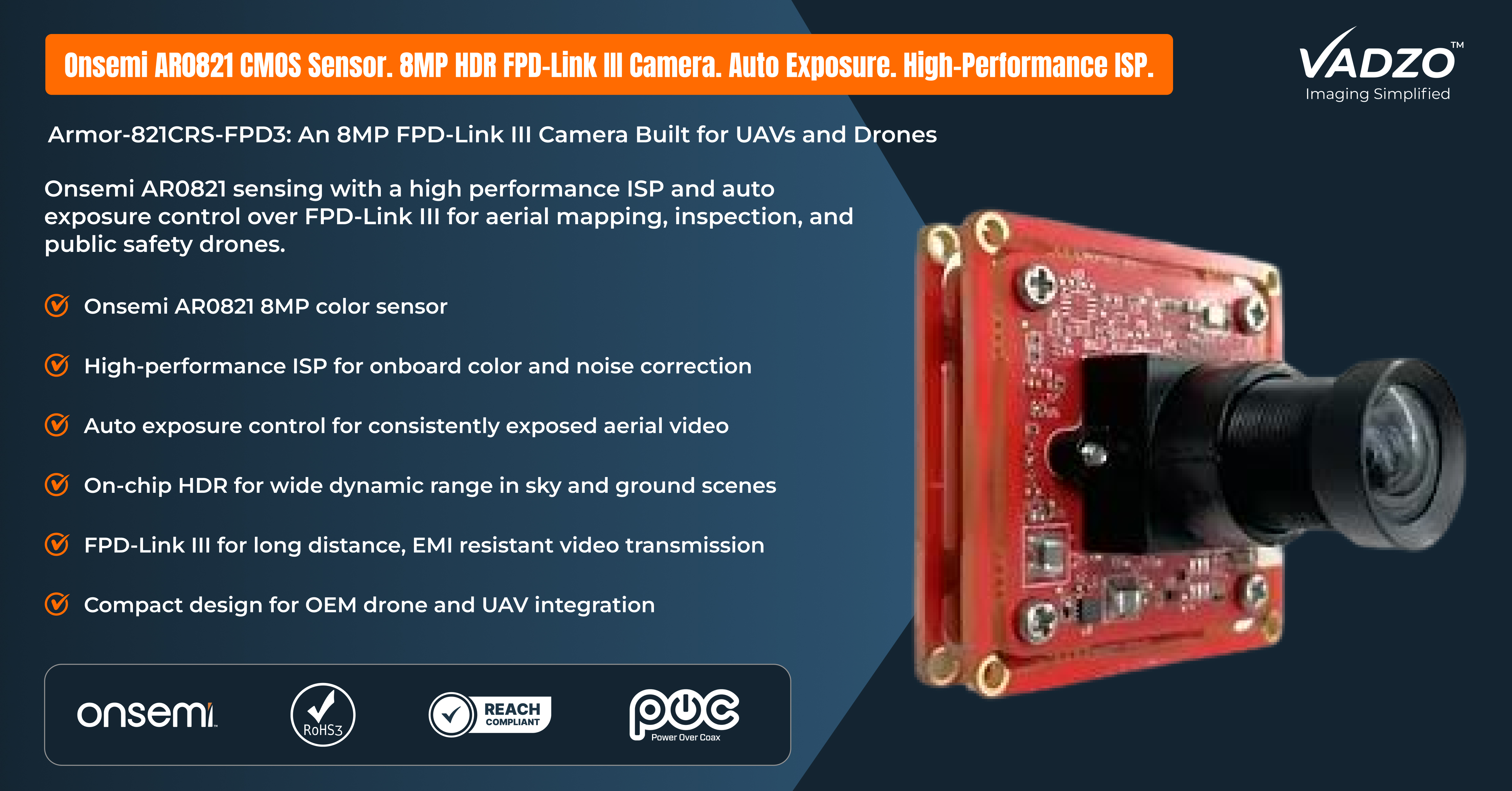
Built for drones and UAV platforms that fly through rapidly changing light between open sky, shadowed terrain, and direct sun, this camera pairs the Onsemi AR0821 sensor with a high-performance ISP and auto-exposure control over FPD-Link III, giving aerial imaging integrators consistently exposed, accurately colored video without a ground station or flight controller doing that correction after the fact.
SAN JOSE, CA / ACCESS Newswire / August 20, 2026 / Vadzo Imaging, a provider of embedded vision solutions, today launched the Armor-821CRS-FPD3, an 8MP FPD-Link III Camera built around the Onsemi AR0821 sensor for UAV, drone, and aerial imaging platforms that need consistently exposed, accurately colored video delivered over a single rugged coax connection back to the flight controller or gimbal electronics.
Why UAVs and Drones Need an 8MP FPD-Link III Camera Built for Changing Light
Aerial platforms encounter lighting extremes that a ground-based camera rarely has to handle within a single flight, let alone a single shot. A drone climbing out of a hangar shadow into open sky, banking to put the sun directly in frame, or descending over dark terrain after a bright horizon shot all present the same underlying problem: exposure that was correct a few seconds earlier is now wrong, and there is no operator standing next to the camera to adjust it manually.
A High Performance ISP Camera approaches this differently than a camera that simply hands raw sensor data to a ground station or flight controller for correction. Processing exposure, color, and noise reduction on the camera itself means the video leaving the aircraft is already usable, rather than requiring a downstream system to guess at corrections from a compressed or bandwidth-limited feed. That distinction matters directly for real-time applications like search and rescue or live inspection, where a delayed or poorly corrected feed defeats the purpose of flying the mission in the first place.
Getting that processed video back to the ground or to onboard recording hardware introduces a second challenge. A camera mounted on a gimbal or a distant part of the airframe needs a cable that tolerates vibration and the electrical noise from motors and transmitters nearby, which is exactly where a Coax Camera for Drones earns its place over a standard USB or wireless video link. Solving the exposure problem without also solving the connectivity problem only gets a manufacturer halfway to a usable aerial imaging system, since a perfectly corrected frame is of little use if the cable carrying it fails partway through a flight.
Engineering Explanation: Exposure, Color, and Connectivity Together
Onsemi built the AR0821 as an 8-megapixel sensor capable of full-resolution still capture and 4K video output, and Vadzo Imaging pairs that sensor with a dedicated image signal processor tuned specifically for the exposure and color challenges aerial platforms present. As an Onsemi AR0821 FPD-Link Camera, the module processes exposure and color correction on the camera itself rather than passing that work downstream, which matters directly when the video feed is also being used for live navigation or inspection decisions.
Auto exposure is the ISP capability that matters most during an actual flight. As an AR0821 ISP Camera, the Armor-821CRS-FPD3 continuously adjusts exposure as lighting conditions change through a flight path, rather than requiring a pilot or camera operator to manually correct settings every time the aircraft’s orientation or altitude shifts the available light. A Smart Exposure Control Camera configuration like this one keeps a horizon shot, a building facade, and a shadowed rooftop all reasonably exposed across the same short flight, which a fixed exposure setting could never manage consistently.
HDR processing works alongside auto exposure rather than replacing it. As an AR0821 HDR FPD-Link III Camera, the sensor extends dynamic range within a single frame, holding detail in both a bright sky and a shadowed building face at the same time. A 4K HDR FPD-Link Camera configuration combines that dynamic range handling with the ISP’s auto exposure and color correction, so the video an aerial platform records or transmits live has already resolved both the frame-level lighting extremes and the flight-level lighting changes before it ever reaches a ground station.
Delivering that processed, HDR video back to the aircraft’s recording or transmission hardware is the final piece of the design. As an AR0821 Coax Camera, the Armor-821CRS-FPD3 uses FPD-Link III to carry that video, along with control signals and power, over a single coaxial cable that tolerates the vibration and electrical noise typical of a UAV’s motors, transmitters, and gimbal mechanics. An AR0821 Power over Coax Sensor configuration removes the need for a separate power cable running alongside the video cable, which matters directly on a weight- and space-constrained airframe where every additional cable adds mass and a potential failure point.
Product Overview
The Armor-821CRS-FPD3 pairs the AR0821 FPD-Link III Camera sensor with a high-performance ISP, auto exposure control, and FPD-Link III connectivity in a compact design suited to drone, UAV, and gimbal integration. As an 8MP FPD-Link III Camera, it outputs full 8-megapixel still resolution or 4K video, giving aerial imaging integrators a single camera platform that covers mapping, inspection, and general-purpose aerial video from one module.
At the core of the module sits the 8MP HDR FPD-Link Camera sensor, chosen specifically for the combination of resolution, dynamic range, and exposure control that aerial platforms require. Because the camera combines 4K Auto Exposure FPD-Link Camera processing with 4K FPD-Link HDR Sensor dynamic range handling, the Armor-821CRS-FPD3 reaches usable image quality across a full flight profile, from a bright open sky shot to a shadowed close inspection pass, all delivered over the same single coaxial connection back to the aircraft’s recording or transmission system.
Key Capabilities
Onsemi AR0821 Sensor for Detailed 8MP / 4K Aerial Capture: The Armor-821CRS-FPD3 is built around the Onsemi AR0821 sensor, a device capable of full-resolution still capture as well as 4K video output from the same hardware. This dual capability matters for aerial platforms that need high-resolution stills for mapping or photogrammetry, alongside lower-latency 4K video for live piloting or inspection feeds, without switching camera hardware between those two tasks. As a 4K Coax ISP Camera, it delivers both resolution modes over the same processed, coax-connected video path, which means a drone manufacturer does not need to qualify two separate camera modules for still and video capture when a single flight might call for both.
High Performance ISP for Clean, Accurate Color in the Air: Raw sensor data straight off an image sensor is rarely usable without correction, and asking a ground station or flight controller to perform that correction on a compressed or bandwidth-limited feed produces worse results than correcting it on the camera itself. As an HDR ISP FPD-Link Camera, the Armor-821CRS-FPD3 handles that processing onboard, delivering already corrected, transmission-ready video rather than raw data that still needs work after it reaches the ground.
Auto Exposure for Consistently Exposed Aerial Video: A fixed exposure setting that looked correct during preflight checks on the ground rarely stays correct once an aircraft is airborne and moving through changing light. As an Auto Exposure Coax Camera, the Armor-821CRS-FPD3 continuously adjusts to those changes in real time, and functioning as an 8MP Auto Exposure Camera, it does so at full resolution rather than only in a reduced-quality preview stream.
HDR for Wide Dynamic Range in Sky and Ground Scenes: A single aerial frame routinely contains both a bright sky and a shadowed ground feature, which is a dynamic range problem a standard exposure setting cannot solve regardless of how well it is tuned. On-chip HDR processing holds detail across that full range in a single exposure, avoiding the ghosting that a moving aircraft or gimbal would introduce into a multi-frame blended HDR image.
FPD-Link III for Long Distance, EMI Resistant Video Transmission: A gimbal-mounted camera often sits some distance from the flight controller or video transmitter, in an environment full of motor and transmitter electrical noise that a standard USB cable was never designed to tolerate. FPD-Link III carries video, control signals, and power over a single coaxial cable engineered for exactly that kind of automotive- and industrial-grade electrical environment, giving drone integrators a dependable link regardless of where on the airframe the camera actually sits.
Compact OEM-Ready Design for Drone and UAV Integration: The module’s compact footprint and weight matter directly on a payload-constrained airframe, where every additional gram affects flight time and handling. As a Drone FPD-Link Camera, it fits directly into standard drone integration workflows already built around this connectivity. Vadzo Imaging supports full customization on this platform as an FPD-Link Drone Camera Kit, including connector changes, housing design, and firmware adjustments for drone manufacturers integrating the camera into a specific gimbal or fixed mount configuration.
“Drone operators do not get to pause a flight and wait for better light. The AR0821’s auto exposure and HDR processing combined with a dedicated ISP gives the Armor-821CRS-FPD3 usable, accurately exposed video throughout an entire flight profile, from a bright open sky shot to a shadowed inspection pass, delivered over a single coax cable that survives life on a gimbal. We built this camera for platforms where the footage has to be usable the moment it lands, not after a ground station finishes correcting it.” – Alwin Vincent, Product Manager at Vadzo Imaging.
Application-Specific Sections
Aerial Surveillance and Mapping: Mapping and surveillance missions depend on consistent image quality across a flight path that may cover open fields, wooded terrain, and urban structures within the same short flight. As a Drone Vision Camera, the Armor-821CRS-FPD3’s auto exposure and HDR processing hold detail across that full range, and functioning as an Aerial Surveillance FPD-Link Camera, it delivers that consistency directly to recording or live transmission hardware.
Drone Payload and Gimbal Integration: Gimbal systems need a camera that delivers stabilized, corrected video without adding excessive weight or a fragile cable connection to an already complex mechanical assembly. As a Drone Payload Camera, the Armor-821CRS-FPD3 integrates directly into existing gimbal designs, and a UAV Gimbal Camera Module configuration of the same module supports both fixed and articulated mounting configurations.
UAV Inspection for Infrastructure, Agriculture, and Utilities: Infrastructure, agricultural, and utility inspection flights need a camera that resolves fine detail on a structure or crop while handling the exposure swings that come with flying close to reflective or shadowed surfaces. As a Drone Inspection Camera Module, the Armor-821CRS-FPD3 supports that close-range inspection work, and as an Aerial Imaging Camera Module, it extends the same capability to broader area survey missions on the same airframe, giving an inspection operator one camera platform that covers both a close pass on a specific structure and a wider area survey of the surrounding site.
Search and Rescue and Public Safety Drones: Search and rescue missions depend on a live video feed that stays usable as an aircraft moves between bright open terrain and shadowed tree cover or structures, often at the exact moment finding someone matters most. A UAV Vision Camera configuration built on this sensor keeps that feed usable across those transitions, and as a UAV Coax Camera, it reaches the aircraft’s transmission hardware reliably regardless of where on the airframe the camera is mounted.
OEM Integration for Drone Manufacturers: Drone and UAV manufacturers building their own airframes need a camera vendor who understands the weight, connectivity, and reliability requirements those platforms demand from the start. The Armor-821CRS-FPD3 ships from a FPD-Link UAV Camera Supplier with those requirements built in, and Vadzo Imaging supports OEM customization for cable length, connector type, and firmware for manufacturers standardizing on one camera across multiple UAV platforms. That standardization becomes more valuable as a manufacturer’s product line grows, since qualifying a single camera platform across several airframe sizes is considerably less engineering work than qualifying a different vendor’s camera for every model in a lineup.
Frequently Asked Questions
Q: Why does a drone camera need a dedicated image signal processor rather than relying on the flight controller or ground station to process video?
A: Correcting exposure, color, and noise on the camera itself means the video leaving the aircraft is already usable, rather than sending raw or lightly compressed data downstream and hoping a flight controller or ground station has enough processing headroom and bandwidth to correct it properly. Flight controllers are generally built to prioritize navigation and control tasks rather than heavy video processing, and a compressed video link rarely preserves enough information for a ground station to make corrections as effectively as processing on the original sensor data would allow. Vadzo Imaging builds a dedicated image signal processor directly into its aerial camera products so the video a drone records or transmits live is already corrected, rather than depending on downstream hardware that was never designed for that job.
Q: Why does auto exposure matter more for aerial video than for a fixed ground camera?
A: A fixed ground camera generally looks at the same general lighting condition for extended periods, giving an operator or an automatic system time to adjust exposure gradually. A drone moving through a flight path can shift from bright open sky to shadowed tree cover, or turn to put the sun directly in frame, within a few seconds, far faster than a manual adjustment could realistically keep up with. Vadzo Imaging builds continuous auto exposure into its aerial camera products specifically because that pace of lighting change is normal for a flight rather than an edge case, and a camera that only handles exposure well in stable lighting is not actually suited to real aerial use.
Q: Why would a drone or UAV use a coax-connected camera instead of a standard USB or wireless video link?
A: A standard USB cable adds weight, bulk, and a connector that was not designed for the vibration a gimbal or airframe introduces, while a wireless video link depends on radio conditions that are not always reliable and typically compresses video enough to lose detail a ground operator or recording system might need. A coax-connected camera using a link like FPD-Link III carries video, control signals, and power over a single lightweight cable engineered for exactly the vibration and electrical noise present on a UAV. Vadzo Imaging designs its aerial camera products around this connectivity so manufacturers get a dependable wired link without the weight of a bulkier standard cable or the reliability compromises of a wireless connection.
Q: Can Vadzo Imaging customize a drone camera module for a specific UAV airframe or gimbal system?
A: Yes. Vadzo Imaging supports full OEM customization across its aerial camera portfolio, including housing design suited to a specific gimbal or airframe mounting position, connector and cable length configuration, and firmware adjustments tuned for a particular auto exposure or HDR profile. Evaluation units ship with no minimum order requirement, and the same engineering team that built the standard product works directly with drone manufacturers to adapt the module for a specific airframe or gimbal system headed into volume production.
Q: What should drone manufacturers look for when choosing a camera supplier for a commercial or industrial UAV platform?
A: Weight and power consumption matter more for a UAV camera than for almost any other application, since every additional gram and milliamp directly affects flight time and payload capacity. Manufacturers should also look for a connectivity approach built for vibration and electrical noise rather than adapted from a desktop interface, along with direct engineering support during integration and a supplier able to support customization for a specific airframe rather than only offering a fixed configuration. Vadzo Imaging builds its aerial camera products around exactly these priorities, since a camera that performs well on a bench but adds unnecessary weight or fails under real flight conditions is not actually a viable choice for a commercial UAV program. A supplier who can speak to all of these factors together, rather than only the camera’s resolution or price, is generally the more dependable choice for a manufacturer planning a long production run.
Availability
The Armor-821CRS-FPD3 8MP FPD-Link III Camera is available now for evaluation and OEM integration. Evaluation kits include the camera module, an FPD-Link III deserializer reference board, mounting hardware suited to common gimbal configurations, and integration documentation covering ISP configuration, auto exposure tuning, and HDR setup, with no minimum order requirement. Contact Vadzo Imaging at support@vadzoimaging.com to request an evaluation unit or discuss volume production and OEM customization.
About Vadzo Imaging
Vadzo Imaging develops embedded and machine vision camera products for OEMs, system integrators, and UAV manufacturers building production-ready vision systems across aerial imaging, robotics, industrial automation, and edge AI. The company’s portfolio spans MIPI CSI-2, USB, GigE, Wi-Fi, FPD-Link III, and SerDes interface camera products, supporting deployment architectures from compact onboard modules to distributed networked and coax-connected installations. Vadzo provides end-to-end imaging support including sensor integration, ISP tuning, firmware development, and SDK frameworks to accelerate system deployment. Visit Vadzo Imaging to explore the full embedded vision camera portfolio.
Media Contact
Alwin Vincent
Vadzo Imaging
Email: alwin@vadzoimaging.com
LinkedIn: Vadzo Imaging
YouTube: Vadzo Imaging
X: Vadzo Imaging
SOURCE: Vadzo Imaging
View the original press release on ACCESS Newswire
Media gallery