
Maryland Survey Finds Strongest Four-Year Run of Juvenile Menhaden Abundance in Over 30 Years
For Fourth Consecutive Year, Menhaden Abundance Exceeds Every Annual Survey Reading From 1992 Through 2022 WASHINGTON,
Press Release Disclaimer: This is a press release distributed through the XPR Media network. It has not been independently verified by our newsroom.


For Fourth Consecutive Year, Menhaden Abundance Exceeds Every Annual Survey Reading From 1992 Through 2022
WASHINGTON, DC / ACCESS Newswire / October 20, 2026 / The Maryland Department of Natural Resources’ (DNR) 2026 juvenile striped bass survey, which tracks the reproductive success of Maryland’s state fish in Chesapeake Bay, has documented another year of abundant juvenile Atlantic menhaden, completing the strongest four-year average of juvenile menhaden abundance since 1988-1991, according to the full survey series dating back to 1959.
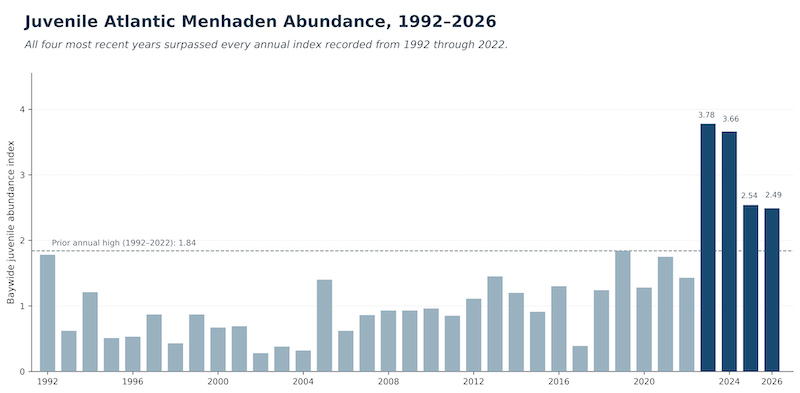
In today’s announcement, Maryland DNR reported that young Atlantic menhaden were again found in abundance during its 2026 juvenile striped bass survey. There was also good news on two other important forage species. Atlantic silversides were recorded in the highest numbers in more than a decade, and the Bay anchovy has shown better than average relative abundance over the past four years.
The underlying menhaden data reveal an especially striking trend. For four consecutive years, from 2023 through 2026, the Bay-wide juvenile menhaden abundance index has exceeded every annual reading recorded during the preceding 31 years, from 1992 through 2022.
The menhaden index reached 3.78 in 2023, followed by 3.66 in 2024, 2.54 in 2025 and 2.49 in 2026. The four-year average of 3.12 is the highest for any consecutive four-year period since 1988-1991.
The results provide substantial evidence of sustained strong juvenile menhaden abundance in Maryland’s Chesapeake Bay survey waters, where menhaden serve as an important food source for predatory fish and birds.
The news for striped bass itself was less encouraging. Maryland reported an eighth consecutive year of below-average striped bass spawning success. However, the 2026 young-of-year index of 5.5 was the highest since 2018, improving from 4.0 in 2025 and 2.0 in 2024. The long-term average is 10.8.
Maryland DNR identified several environmental factors that can affect striped bass spawning success, including winter temperatures, spring rainfall and river flows. The agency noted that prolonged regional drought and resulting low river flows may have contributed to unfavorable spawning conditions in 2026.
Maryland’s latest survey adds four more years of strong juvenile menhaden observations to the scientific record as fisheries managers consider the future of menhaden management in the Chesapeake Bay. While the juvenile survey does not directly measure adult menhaden biomass or availability in particular areas, its findings provide important evidence about the Bay’s forage fish population.
The Atlantic States Marine Fisheries Commission (ASMFC) has also explained that ending all menhaden fishing would not, by itself, rebuild the striped bass population to its biomass target. The ASMFC manages Atlantic menhaden using ecological reference points designed to account for the forage needs of striped bass and other predators.
Sources: Maryland DNR announcement | Maryland DNR juvenile striped bass survey | the ASMFC Atlantic Menhaden FAQs
About the Menhaden Fisheries Coalition
The Menhaden Fisheries Coalition (MFC) is a collective of menhaden fishermen, related businesses, and supporting industries. Comprised of businesses along the Atlantic and Gulf coasts, the Menhaden Fisheries Coalition conducts media and public outreach on behalf of the menhaden industry to ensure that members of the public, media, and government are informed of important issues, events, and facts about the fishery.
Press Contact
Menhaden Fisheries Coalition
(202) 595-1212
www.menhaden.org
SOURCE: Menhaden Fisheries Coalition
View the original press release on ACCESS Newswire
Media gallery
