New Voya Index Finds Workplace Education Drives Financial Confidence and Positive Action More Than Money
Inaugural America’s Financial Confidence Index™ Uncovers a “Confidence Gap” Between How Employees Feel and What They
Press Release Disclaimer: This is a press release distributed through the XPR Media network. It has not been independently verified by our newsroom.


Americans feel better about their finances than their habits reflect. America’s Financial Confidence IndexTM, a new nationwide benchmark from Voya Financial, Inc. (NYSE: VOYA), finds that U.S. workers remain financially optimistic despite the current economic landscape — but their confidence often outpaces their actions.
This press release features multimedia. View the full release here: https://www.businesswire.com/news/home/20261014284190/en/
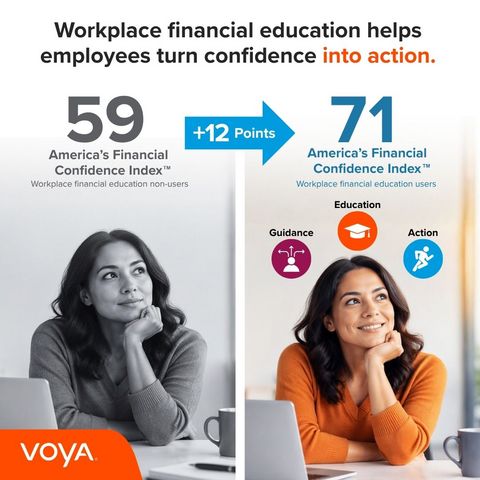
Employees who actively use workplace financial education scored 71 on financial behaviors, versus 59 for those who don’t, outperforming every other group measured, including the wealthiest workers surveyed.
On average, workers scored 67 out of 100 for financial confidence, compared with 62 out of 100 for the financial behaviors needed to reach their goals, creating a five-point “confidence gap.” The strongest link to closing the gap isn’t income or assets. It’s the workplace. Employees who actively use workplace financial education scored 71 on financial behaviors, versus 59 for those who don’t, outperforming every other group measured, including the wealthiest workers surveyed. Similarly, those who work with a financial professional scored significantly higher at 69, compared with 57 for those who don’t.
Based on a survey of more than 4,000 employed Americans, Voya’s index measures both how workers feel about their finances and the actions they take to achieve their financial goals. It assesses sentiment and behavior across six dimensions of near- and long-term financial well-being: managing everyday finances, protecting against risk, preparing for unexpected expenses, enjoying life today, reducing debt and building long-term financial security. Unlike one-size-fits-all checklists, each person’s score reflects the steps they are taking toward these goals, weighted by the goals that matter most to them.
“Confidence only matters when it’s backed by action,” said Jay Kaduson, CEO of Workplace Solutions, Voya Financial. “America’s Financial Confidence IndexTM gives us a new way to make confidence measurable. It shows the gap between how people feel and what they do can be closed. When people have access to the right guidance, protection and long-term investment support, they don’t just feel more confident — they can take meaningful action to pursue stronger financial outcomes. In fact, 94% of participants* who go through Voya’s financial wellness experience say they have taken or plan to take steps to improve their financial situation, reinforcing the powerful connection between confidence and action.”
Additional findings show that financial confidence reflects both workers’ personal financial experiences and broader factors — including economic expectations and access to workplace education and guidance — that influence how they plan and make financial decisions:
- Americans are more optimistic about themselves than the economy: While only 38% of workers expect good economic conditions over the next 12 months, 43% believe their personal situation will improve during that time, demonstrating a bit more optimism about their own finances than the broader economy.
- Financial stress creates a “tax” on confidence: More than one-third (35%) of workers say they are always or often stressed about money, and 70% of those experiencing financial stress report that it negatively affects their financial confidence.
- There is a disconnect between planning and achieving retirement security: Workers are more confident in their ability to create a retirement plan (66%) than they are in achieving long-term financial security (45%), resulting in a 21–point gap between planning for retirement and believing they will reach their goals.
- Emergency preparedness is a top financial priority: When asked what matters most to their financial confidence, workers ranked having enough money available to cover an unexpected $2,500 expense above every other financial goal, including retirement readiness, debt reduction and enjoying their current lifestyle without jeopardizing their financial future.
- Three distinct financial profiles emerged: The index research found that individuals fell into three distinct groups: Confident Doers (66%) who have high confidence and high financial behavior; Comfortable Coasters (25%) who feel financially confident despite taking fewer actions; and Anxious Achievers (10%) who take many of the right financial actions but lack confidence in their financial situation. These profiles reinforce how financial wellness programs should be tailored to individual needs rather than one size fits all.
“The workplace is one of the most powerful places to help people build financial security, and our research reinforces the important role employers can play in the process,” Kaduson said. “At Voya, we’re focused on helping working Americans build confidence through education, guidance and workplace benefits. Through our Guided Confidence™ financial education and guidance platform, we’re helping make tools and resources more accessible so that more people, regardless of income or assets, can make informed decisions and move closer to their goals.”
Learn more about America’s Financial Confidence Index at https://www.voya.com/financial-confidence-index
*Source: Voya internal Financial Wellness feedback survey, May 2019 through September 2025. Results reflect responses submitted after participants completed the Financial Wellness experience. Based on approximately 26,000 responses.
About America’s Financial Confidence IndexTM
America’s Financial Confidence IndexTM (AFCI) is a proprietary workplace financial confidence benchmark developed by Voya Financial. The index measures whether U.S. employees are doing the concrete behaviors that lead to financial confidence. The inaugural study surveyed 4,097 employed, benefits-eligible Americans ages 25 to 64 who participate in workplace retirement plans. Conducted between June 22 and July 5, 2026, AFCI measures both self-reported financial confidence and financial behaviors across six core financial goals people feel are most important, providing a comprehensive view of Americans’ financial readiness and resilience.
About Voya Financial®
Voya Financial, Inc. (NYSE: VOYA) is a leading retirement, employee benefits and investment management company. Voya’s services and solutions help clear the path to financial confidence and a more fulfilling life for individual, workplace and institutional clients, supporting more than 18 million customer relationships. Certified as a “Great Place to Work” by the Great Place to Work® Institute, Voya fosters a culture that values customer centricity, integrity, accountability, agility and inclusivity. Together with customers and partners, Voya employees fight for everyone’s opportunity for a better financial future. For more information visit voya.com and follow Voya Financial on LinkedIn, Facebook and Instagram.
VOYA-RET CN5997698_1028
View source version on businesswire.com: https://www.businesswire.com/news/home/20261014284190/en/
Media gallery