Supertab Launches Supertab Connect, Giving Content Owners Visibility Into Which AI Bots Are Hitting Their Servers
NEW YORK, NY, September 14, 2026 (EZ Newswire) -- New York-based Supertab today launched Supertab Connect, a bot and
Press Release Disclaimer: This is a press release distributed through the XPR Media network. It has not been independently verified by our newsroom.
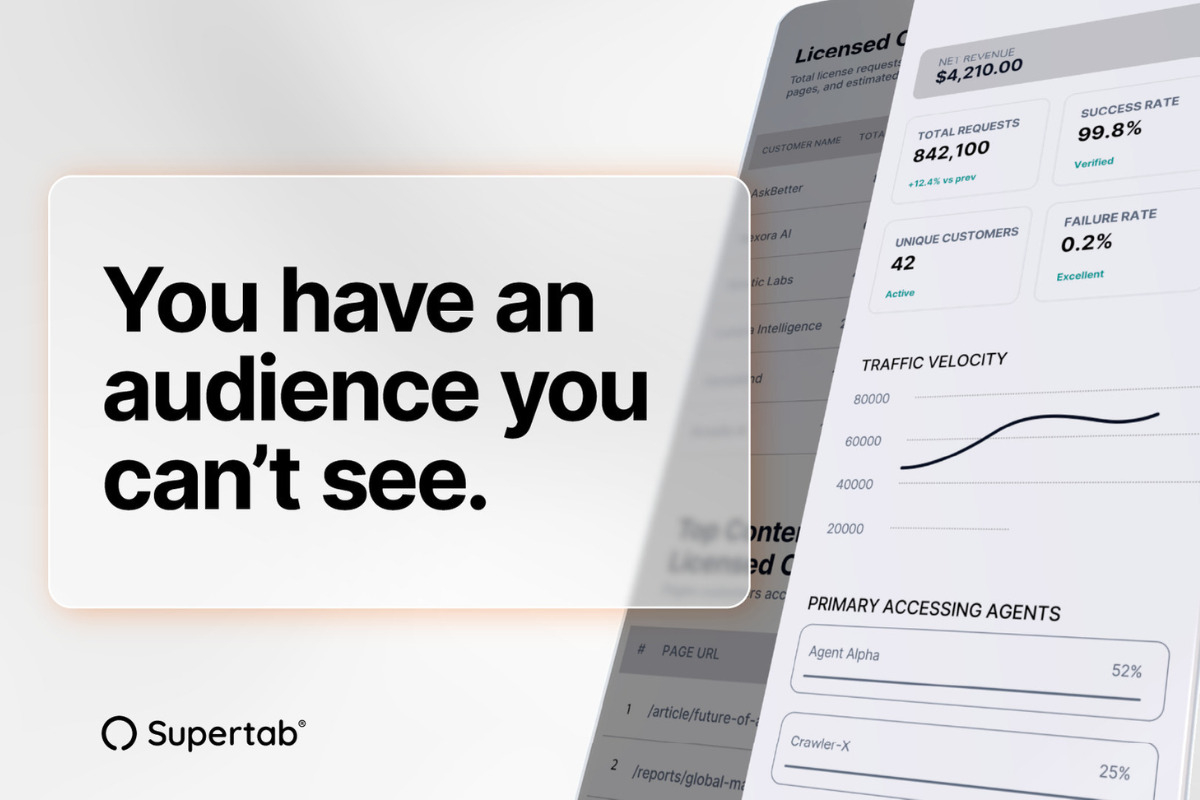

NEW YORK, NY, September 14, 2026 (EZ Newswire) — New York-based Supertab today launched Supertab Connect, a bot and agent classification product built for site owners who can see that their traffic is automated but cannot tell what any of it is for.
More than half of all traffic on the internet is now non-human, according to Cloudflare’s July 2026 bot report. Most site owners discover that fact as a set of symptoms rather than a statistic. Origin load climbs and nobody can say why. Bandwidth costs step up without a corresponding step up in readers. The site slows at hours that do not match human traffic. Someone finally opens the server logs and finds enormous volume with no meaning attached to it.
A site owner who suspects half their traffic is not real cannot confirm it in analytics. Conventional web analytics is built around human sessions and discards most automated requests before they are ever reported, so the dashboard comes back clean, and robots.txt is not always read or respected. Supertab Connect measures at the CDN edge instead, where automated requests are visible before any analytics filtering removes them.
A web request does not carry its own purpose. A crawler collecting training data, a retrieval grounding a live answer in ChatGPT or Perplexity, and an agent fetching a page because a user asked it to all produce the same GET. At the HTTP layer they are indistinguishable; commercially they have almost nothing in common. Cloudflare reported in July 2026 that mixed-use crawlers, operators running search, agent traffic and training collection through one fleet, account for over 36% of activity, so even correctly identifying the company behind a request no longer settles what the request was for.
Supertab Connect classifies automated traffic by the operator behind it and the category of activity it represents, at the site owner’s existing CDN edge: it names the operator behind each agent, sorts requests by the kind of activity each represents, and resolves them to the URLs requested — so a site owner can see where automated interest concentrates instead of inferring it from an operator-level count. Supertab Connect also surfaces agents that appear on a site for the first time in a given period.
Search referrals are falling for reasons that have nothing to do with rankings. Pew Research found in 2025 that when Google shows an AI summary, users click a traditional result 8% of the time, down from 15% when no summary appears. That is an answer-surface change, and no analytics or classification product reverses it. What Supertab Connect answers is the adjacent question a site owner can act on: which operators are taking the content and which pages they take.
“Every operations team already knows the traffic is automated. What they can’t answer is what it’s for, and almost every decision they need to make depends on that answer,” said Cosmin Ene, founder and CEO of Supertab. “The block-or-allow argument has been running for two years without resolving, and the reason is that most of the people arguing it can’t see what they’re deciding about. Blanket blocking forfeits discovery and teaches you nothing. Blanket allowing is just not looking. And assuming every AI request represents licensing demand is equally dangerous. First find out who wants what.”
Supertab Connect deploys into infrastructure the site owner already runs. It works on all major CDN’s, as well as via a WordPress plugin or SDK. There is no proxy subdomain, no DNS change, no network to join, and no commercial agreement with any AI company is required to switch classification on. Sites can be live in hours, with a first report drawn from their own traffic.
Supertab Connect identifies and reports; it does not block requests. Supertab’s position is that blocking a named operator remains a legitimate instrument: one of the few diagnostic tools a site owner has, since blocking can also reveal whether an operator actually depends on a site’s content. If the content is substitutable, nothing may happen; if it is genuinely valuable to that operator, the resulting behavior becomes a useful demand signal.
Supertab separately operates a licensing and access layer for cases where an AI company or agent needs content that a site owner chooses to make commercially available: machine-readable terms published on the publisher’s own domain using the open RSL 1.0 standard, with token issuance for agents that accept them. Classification neither requires it nor depends on it, and the two are separate views in the product today. A site owner moving from observing to managing does not have to start over with a different vendor.
Supertab Connect is available now, with a one-month free trial for new customers at supertab.co.
Common Questions From Site Owners
Is AI scraping my website?
Almost certainly some automated traffic is reaching it. More than half of internet traffic is now non-human. The useful question is not whether, but which operators: OpenAI, Anthropic, Perplexity, Google and dozens of smaller ones behave differently and want different things. Supertab Connect names the operator behind each agent and classifies what kind of activity it represents.
What is all this non-human traffic in my server logs?
Logs record a user agent string, an IP and a path. The user agent is self-declared and tells you nothing reliable about purpose. Supertab Connect resolves requests to the operator behind them, sorts them by the kind of activity each represents, and shows which URLs each is requesting.
Do I need a separate AI bot tool if I already have a WAF and CDN logs?
A WAF answers whether a request is malicious. CDN logs answer what was requested. Neither answers what the request is for, which is the question that determines whether traffic is worth serving, blocking or or managing differently. Supertab Connect runs inside that same CDN edge and adds the classification layer rather than replacing anything.
My site got slower and I cannot find the cause. Could bots be the reason?
It is a common cause and a commonly missed one, because automated load does not show up in the analytics most teams check first. Classifying automated requests at the edge shows what share of origin requests are non-human, which operators drive the volume, and which paths absorb it.
Are scrapers skewing the numbers in my analytics?
Conventional analytics filters most automated traffic out rather than reporting it, so the more likely distortion is absence, not inflation — decisions get made on a picture that excludes a majority of actual requests. Classification at the edge measures the requests analytics never sees.
How do I quantify what AI crawler traffic is costing us in infrastructure?
You need three inputs: the share of requests that are automated, which operators account for them, and which paths they concentrate on. Supertab Connect produces all three from a site’s own traffic. The cost model is the site owner’s; the measurement underneath it is what has been missing.
Should I treat user-triggered AI agents differently from training crawlers?
Most site owners conclude yes. An agent fetching a page because a reader asked for it is closer to a visit; a crawler collecting training data is closer to a bulk copy. They are identical in a log file, which is why the distinction has to be made deliberately: classification by activity type is what makes it available.
How do I block ChatGPT from my site without hurting my Google traffic?
Distinguishing them is the prerequisite, and it is harder than it looks: several major operators run search, retrieval and training collection through overlapping infrastructure. Supertab Connect classifies by activity, not just by company, so a decision can be made about a specific operator and behaviour rather than about “AI” in general. Supertab Connect reports; blocking is applied by the site owner at their own edge.
Is blocking AI crawlers bad for SEO, or bad for AI visibility?
Blanket blocking costs discovery in both. Blocking a specific operator is a different decision, and a defensible one. It can also be diagnostic. What happens after access disappears helps establish whether that content actually matters to the operator. Either way, the precondition is being able to tell one agent from another.
Why is my organic traffic down when my rankings have not moved?
Rank and referral have decoupled. Pew Research found in 2025 that when Google shows an AI summary, users click a traditional result 8% of the time, down from 15% when no summary appears. That is an answer-surface change, not a ranking problem, and no crawler tool reverses it. What classification tells you is the adjacent, actionable fact: which operators are consuming the content and which pages they take.
What should I do first if I discover AI bots are scraping my site?
Measure before deciding. Establish which operators are present, what kind of activity each represents, and which pages they concentrate on. Every option after that depends on that baseline: allow, block selectively, publish terms, or open a conversation. A decision made without it is a guess.
What is the cheapest way for a small site owner to see AI crawler activity?
Supertab Connect is offering new customers a free trial period and deploys into a site’s existing CDN, including Fastly, Cloudflare, CloudFront, or via a WordPress plugin, with no proxy, no DNS change, and no agreement with an AI company required first.
About Supertab
Supertab is the infrastructure for consumption-based commerce. Its products include Supertab Connect, which classifies the automated traffic reaching a website by the operator behind it and the kind of activity it represents, and a licensing layer that publishes machine-readable terms on a site owner’s own domain using the open RSL 1.0 standard. As AI agents and automated systems become major consumers of content, services and compute, Supertab meters, prices, and settles that usage across humans, agents, and enterprises in a single economic layer, so that what machines consume can be measured and paid for as it happens. For more information, visit www.supertab.co.
Media Contact
Cosmin Ene
Founder and CEO, Supertab
press@supertab.co
SOURCE: Supertab