5G Infrastructure Market Projected to Surpass USD 159.5 Billion at 25.2% CAGR by 2035
5G Infrastructure Market is expanding rapidly, driven by rising data demand, IoT adoption, smart cities, and
Press Release Disclaimer: This is a press release distributed through the XPR Media network. It has not been independently verified by our newsroom.

5G Infrastructure Market is expanding rapidly, driven by rising data demand, IoT adoption, smart cities, and low-latency connectivity needs.
NEW YORK(NY), NY, UNITED STATES, August 26, 2026 /EINPresswire.com/ — The 5G Infrastructure Market is entering a phase of rapid build-out as telecom operators, enterprises, and governments race to deploy next-generation wireless networks capable of supporting massive data volumes, ultra-low-latency applications, and billions of connected devices. 5G infrastructure encompasses the small cells, macro towers, core network equipment, fiber backhaul, and radio access network (RAN) components that together enable faster speeds and more reliable connectivity than previous generations.
Unlike earlier wireless upgrades, 5G is being engineered from the outset to support demanding use cases such as autonomous vehicles, industrial IoT, smart cities, and immersive AR/VR experiences, making infrastructure investment a strategic priority rather than a routine network refresh.
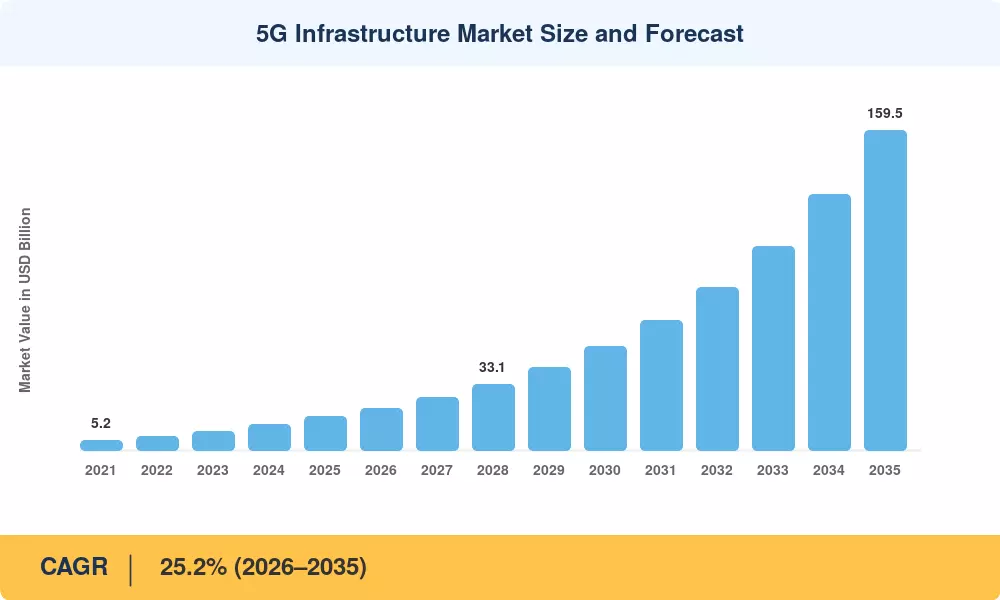
The 5G Infrastructure Market reached an estimated USD 16.8 billion in 2025 and is projected to grow from USD 21.1 billion in 2026 to USD 159.5 billion by 2035, reflecting a compound annual growth rate of 25.2% across the forecast period. This steep growth curve is being driven by accelerating spectrum allocation, falling equipment costs, and surging demand for high-bandwidth connectivity across consumer and enterprise segments alike.
Governments worldwide are also treating 5G rollout as critical national infrastructure, channeling public funding and favorable policy toward faster deployment. As standalone (SA) 5G architecture matures and network slicing becomes commercially viable, infrastructure investment is expected to shift further toward core network modernization alongside continued radio access expansion.
Get a Sample Copy of this Report –
https://www.marketresearchfuture.com/sample_request/10527
Key Players and Competitive Insights
The 5G Infrastructure Market is highly competitive, dominated by a handful of large telecommunications equipment manufacturers alongside a growing base of specialized RAN, small-cell, and networking software vendors. Leading companies continue to invest heavily in research and development, particularly around open RAN compatibility, energy-efficient hardware, and AI-driven network optimization.
Strategic partnerships between equipment vendors, telecom operators, and cloud providers have become central to competitive positioning, as have long-term supply agreements tied to national infrastructure projects.
Major market participants include:
• Huawei Technologies Co., Ltd.
• Ericsson
• Nokia Corporation
• Samsung Electronics
• ZTE Corporation
• Cisco Systems Inc.
• Qualcomm Incorporated
• NEC Corporation
• Mavenir Systems
• CommScope Holding Company
• Fujitsu Limited
• Corning Incorporated
• American Tower Corporation
• Crown Castle Inc.
• Airspan Networks
These companies continue to expand their portfolios across RAN hardware, core network software, small-cell systems, and network management platforms. Many vendors are integrating artificial intelligence and machine learning into network operations to enable predictive maintenance, dynamic spectrum management, and automated fault resolution, while tower and infrastructure companies expand site portfolios to support densification.
Market Dynamics: Drivers, Restraints and Opportunities Drivers
Explosive growth in mobile data consumption is the foundational driver behind 5G infrastructure investment. Video streaming, cloud gaming, and always-connected IoT devices are pushing existing 4G networks to their capacity limits, compelling operators to deploy denser small-cell networks and upgrade backhaul capacity.
Enterprise adoption is another significant driver, with manufacturers, logistics companies, and healthcare providers increasingly deploying private 5G networks to support automation, real-time monitoring, and low-latency industrial control systems. Government-backed spectrum auctions and national digital infrastructure programs are further accelerating rollout timelines, particularly in regions competing for technological leadership.
The parallel rise of edge computing is also reinforcing demand, since ultra-low latency applications require infrastructure that processes data closer to the end user rather than routing it through distant centralized data centers.
Despite the strong growth trajectory, several factors continue to restrain faster market expansion. The capital intensity of deploying dense small-cell networks and upgrading fiber backhaul remains substantial, particularly for operators in cost-sensitive or lower-density markets. Site acquisition and permitting delays, especially for small-cell installations in urban areas, continue to slow rollout in several regions.
Spectrum availability and allocation policies also vary widely by country, creating inconsistent deployment timelines globally. Additionally, concerns around network security, supply chain vulnerabilities involving certain equipment vendors, and the technical complexity of integrating 5G with existing 4G infrastructure add further friction, particularly for smaller or regional telecom operators working with constrained budgets.
Meaningful opportunities continue to emerge alongside these challenges. The expansion of private 5G networks across manufacturing, mining, ports, and logistics represents a high-value growth avenue as enterprises seek dedicated, secure connectivity independent of public carrier networks. Fixed wireless access (FWA) is opening new revenue streams by offering 5G-based home and business broadband in areas where fiber deployment is impractical.
Network slicing and edge computing integration present opportunities for operators to monetize differentiated service tiers for latency-sensitive applications. Additionally, open RAN architecture is gaining momentum as operators seek to reduce vendor lock-in and lower long-term equipment costs, opening the door to a broader, more competitive supplier ecosystem.
Buy this Premium Research Report at –
https://www.marketresearchfuture.com/checkout?currency=one_user-USD&report_id=10527
Market Segmentations
By Component
• Hardware
• Software
• Services
By Network Architecture
• Non-Standalone (NSA)
• Standalone (SA)
By Network Technology
• Small Cell
• Macro Cell
• Radio Access Network (RAN)
• Core Network
• Backhaul & Transport
• Distributed Antenna Systems (DAS)
By Deployment Type
• Public Networks
• Private Networks
By Frequency Band
• Sub-6 GHz
• mmWave
By End User
• Telecom Operators
• Enterprises
• Government
• Manufacturing
• Healthcare
• Automotive & Transportation
• Media & Entertainment
• Others
By Region
• North America
• Europe
• Asia-Pacific
• South America
• Middle East & Africa
Regional Insights
Asia-Pacific currently leads the 5G Infrastructure Market, accounting for 42% of global revenue share in 2025. The region’s strong position is driven by aggressive rollout programs in China, South Korea, and Japan, along with rapidly expanding deployments across India and Southeast Asia. State-led mass deployment, private 5G networks, and fixed wireless access (FWA) are key investment themes supporting regional growth. Strong government backing, domestic equipment manufacturing capacity, and dense urban populations have made Asia-Pacific the fastest-moving region for both consumer and enterprise 5G infrastructure.
North America holds a substantial market share, with the region reaching USD 4.7 billion in 2025. Growth is supported by heavy investment from major carriers, extensive fixed wireless access rollout, and early enterprise adoption of private 5G networks across manufacturing and logistics. The United States remains a key contributor, while mid-band network densification, enterprise 5G deployments, FWA expansion, spectrum availability, and rural connectivity initiatives continue to support infrastructure spending.
Europe continues to expand steadily and accounted for approximately 21% of revenue share in 2025. Growth is shaped by coordinated spectrum policies across the European Union, strong industrial automation demand in Germany, and national digital infrastructure targets in the United Kingdom and France. Vendor diversification and Open RAN pilot programs are becoming important investment themes as European operators seek flexible network architectures and greater supply-chain resilience.
South America is witnessing gradual but steady growth, with the region projected to register a 23.8% CAGR from 2026 to 2035. Operators in Brazil, Mexico, and Argentina are expanding network coverage beyond major metropolitan areas, creating opportunities for greenfield infrastructure deployment. Spectrum auctions, expanding mobile connectivity, and increasing demand for reliable broadband services are expected to support continued investment throughout the forecast period.
The Middle East & Africa region is emerging as a promising growth market, with the sector valued at approximately USD 0.67 billion in 2025. Smart city initiatives in the Gulf states and increasing investment in digital infrastructure across parts of Africa are encouraging 5G deployment. Fixed wireless access is also becoming an important investment theme for expanding broadband connectivity, particularly in areas where traditional fixed-line infrastructure remains limited.
Browse Full Report Details –
https://www.marketresearchfuture.com/reports/5g-infrastructure-market-10527
Recent Developments
Leading equipment vendors are expanding open RAN-compatible product lines to meet growing operator demand for multi-vendor network flexibility.
Telecom operators are accelerating standalone (SA) 5G core deployments to enable network slicing and support enterprise-grade private network offerings.
Tower and infrastructure companies continue expanding small-cell and macro-site portfolios to support urban network densification.
Strategic partnerships between telecom operators and cloud providers are increasing, aimed at integrating edge computing capabilities with 5G infrastructure.
Fixed wireless access deployments are expanding rapidly as operators target underserved and rural broadband markets using 5G infrastructure.
Frequently Asked Questions (FAQs)
Q1. What is the 5G Infrastructure Market?
It refers to the hardware, software, and services that enable 5G wireless network deployment, including RAN, core network, and backhaul components.
Q2. What is driving market growth?
Rising mobile data demand, enterprise private network adoption, and government-backed spectrum and infrastructure programs.
Q3. Which industries are adopting private 5G networks?
Manufacturing, logistics, mining, ports, and healthcare are among the leading adopters.
Q4. Which region dominates the market?
Asia-Pacific currently leads due to aggressive rollout in China, South Korea, and Japan.
Q5. Which region is growing fastest?
Asia-Pacific is also projected to post the fastest growth rate through 2035.
Q6. What technologies support 5G infrastructure?
Small cells, open RAN, edge computing, network slicing, and AI-driven network optimization.
Q7. What are the major challenges facing the market?
High deployment costs, permitting delays, and spectrum allocation inconsistencies across regions.
Q8. What is the market outlook through 2035?
The market is expected to grow from USD 21.1 billion in 2026 to USD 159.5 billion by 2035, at a 25.2% CAGR.
➤➤Explore Regional and Country-Level Reports for the Main Keyword to Gain Deeper Market Insights.
Canada 5G Infrastructure Market-
https://www.marketresearchfuture.com/reports/canada-5g-infrastructure-market-58496
China 5G Infrastructure Market-
https://www.marketresearchfuture.com/reports/china-5g-infrastructure-market-58501
Europe 5G Infrastructure Market-
https://www.marketresearchfuture.com/reports/europe-5g-infrastructure-market-58499
France 5G Infrastructure Market-
https://www.marketresearchfuture.com/reports/france-5g-infrastructure-market-58495
Gcc 5G Infrastructure Market-
https://www.marketresearchfuture.com/reports/gcc-5g-infrastructure-market-58497
Germany 5G Infrastructure Market-
https://www.marketresearchfuture.com/reports/germany-5g-infrastructure-market-58493
India 5G Infrastructure Market-
https://www.marketresearchfuture.com/reports/india-5g-infrastructure-market-58500
Italy 5G Infrastructure Market-
https://www.marketresearchfuture.com/reports/italy-5g-infrastructure-market-58498
Japan 5G Infrastructure Market-
https://www.marketresearchfuture.com/reports/japan-5g-infrastructure-market-58494
Spain 5G Infrastructure Market-
https://www.marketresearchfuture.com/reports/spain-5g-infrastructure-market-58502
Uk 5G Infrastructure Market-
https://www.marketresearchfuture.com/reports/uk-5g-infrastructure-market-58492
Us 5G Infrastructure Market-
https://www.marketresearchfuture.com/reports/us-5g-infrastructure-market-14469
Market Research Future
Market Research Future
+1 855-661-4441
email us here
Legal Disclaimer:
EIN Presswire provides this news content “as is” without warranty of any kind. We do not accept any responsibility or liability
for the accuracy, content, images, videos, licenses, completeness, legality, or reliability of the information contained in this
article. If you have any complaints or copyright issues related to this article, kindly contact the author above.

Media gallery